


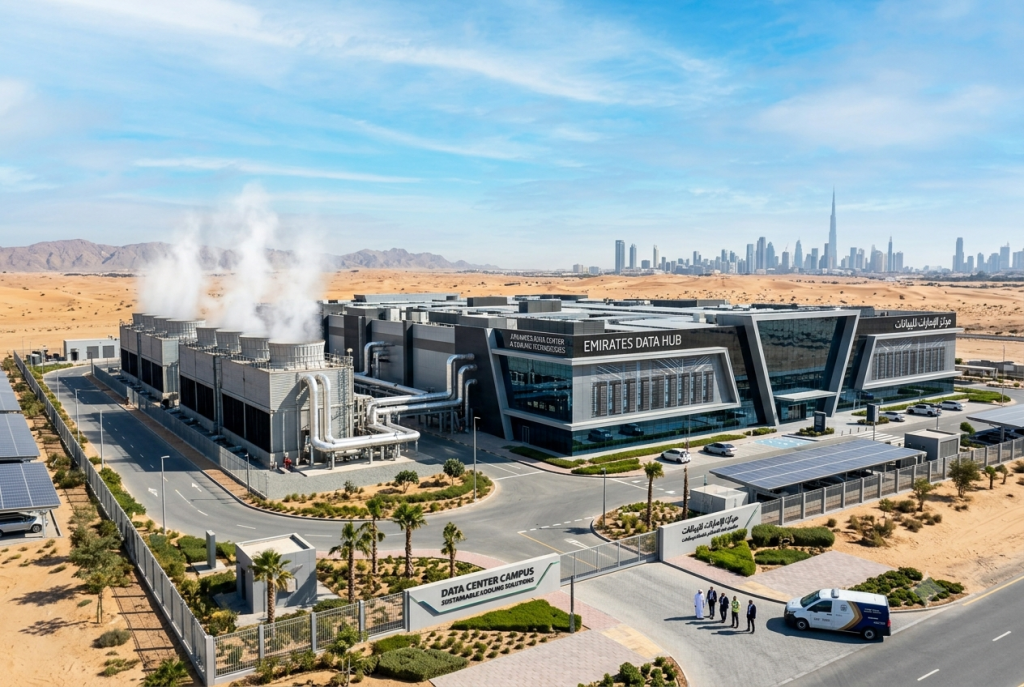
Data Center Cooling Towers in the UAE & GCC
Data Center Cooling Towers in the UAE & GCC: How to Beat 50°C Summers Without Risking Uptime
It’s the wet-bulb, not the thermometer
A cooling tower cools water mainly by evaporation. How well it does that depends on the wet-bulb temperature: a measure that combines air temperature and humidity. Wet-bulb sets the lowest temperature the tower can ever cool water to.
That is why a dry 48°C day inland can be easier on a cooling tower than a humid 40°C day on the coast. In coastal cities such as Dubai, Abu Dhabi, Doha, Dammam and Muscat, summer humidity pushes design wet-bulb values among the highest in the world.
The risk of using a generic design point
Many cooling towers are selected around a standard wet-bulb of 27–28°C. In parts of the Gulf, real summer wet-bulb conditions run several degrees higher. A tower selected too low will deliver warmer water exactly when the data hall needs it most.
Warmer condenser water means:
- Chillers draw more power for the same cooling, raising PUE
- Chillers move closer to high-pressure trips
- Less headroom for IT load growth and hotter future summers
Best practice: select the tower on the site’s ASHRAE 0.4% design wet-bulb, or the client’s stricter figure, and add a margin for climate trends and planned expansion. Bell’s design and engineering team does this site by site.
Approach temperature: the number that drives your total cost
Approach is the gap between the cold water leaving the tower and the ambient wet-bulb. If the design wet-bulb is 30°C and the tower delivers 34°C water, the approach is 4°C.
- A tighter approach (2–3°C) gives colder water and more efficient chillers, but needs a larger, more expensive tower.
- A wider approach (6–7°C) gives a smaller tower, but the chillers pay the price in energy every day of their life.
For most GCC data centers, an approach of around 3–5°C gives the best balance of capital cost and lifetime energy. The right number depends on your chiller type, electricity tariff and expansion plans. Bell models tower size against chiller power so you can see the trade-off in kW and dirhams, not just degrees.
Which cooling tower type suits a GCC data center?
There is no single “best” tower. The right choice depends on load, site, water availability and noise limits.
| Tower type | Best suited to | Water use | Key benefit |
|---|---|---|---|
| Induced draught cooling towers | Large central chiller plants | Standard | High thermal efficiency, compact footprint, proven at scale |
| Industrial induced draft cooling towers | Hyperscale and campus sites | Standard | Field-erected multi-cell designs for very high loads |
| Adiabatic cooling towers | Water-scarce or high water-cost sites | Low | Runs dry for much of the year and wets only at peak |
| Low noise series | Urban, edge and mixed-use sites | Standard | Meets strict day and night noise limits |
| Forced draft cooling towers | Indoor, ducted or space-limited plant rooms | Standard | Fans at air inlet for easier service access |
The hybrid approach
Many operators now combine tower types. Induced draft cells carry the summer base load, while adiabatic units take over in the cooler months from November to March, when they can run with little or no water. This mix cuts annual water use without risking capacity on peak days.
Free cooling in winter
Gulf winters bring wet-bulb temperatures low enough, for part of the year, to support water-side economisation. With a plate heat exchanger, the cooling tower can cool the data hall directly while chillers rest. Even a few months of partial free cooling makes a measurable difference to annual PUE.
Designing for uptime, not just capacity
A data center cannot pause for cooling tower maintenance. These features belong in every GCC specification:
- N+1 or 2N cell redundancy. Any one cell can be taken offline for service while the plant still meets full design load on the hottest day.
- Variable frequency drives (VFDs) on fans. Fan speed follows IT load and ambient conditions, cutting fan energy sharply at part load.
- Independent cells with isolation valves. One cell can be drained, cleaned or repaired without affecting the others.
- CTI-certified thermal performance. Independent certification proves the tower delivers its rated capacity. Bell offers 142+ CTI-certified models, with its CTI selection matrix available to download.
- Integration with BMS and DCIM. Tower alarms and performance data should appear on the same screens your operators already watch.
Sand, dust and salt: the hidden enemies
Shamal winds and dust storms carry huge amounts of fine sand. A cooling tower moves enormous volumes of air, so it acts like a giant dust collector. Sand settles in the basin, clogs fill and strainers, and wears pumps.
Protect against it with:
- Air inlet screens or louvres designed for dusty climates
- Side stream filters that continuously remove sand and suspended solids from circulating water
- Sloped basins and sweeper piping that make sludge easy to flush out
On coastal sites, salt air adds a second threat: corrosion. Specify FRP casings and basins, SS316 hardware, and corrosion-resistant motors. Scaling treatment and protection keeps both scale and corrosion under control.
Cutting water use in a water-scarce region
Water is often the hidden constraint for GCC data centers. Most of the region’s fresh water comes from energy-intensive desalination, and authorities are watching consumption closely. A large chiller plant’s cooling towers can use a significant amount of water every day.
Three levers make the biggest difference:
- Raise cycles of concentration (COC). Every extra cycle cuts blowdown. Bell’s Oscillation Ring Technology keeps minerals in suspension so towers can run at higher COC without scaling. An automated chemical dosing system holds inhibitor levels steady.
- Use adiabatic operation in cooler months to run dry where possible.
- Use treated sewage effluent (TSE) as makeup water where available and permitted, with treatment designed for its chemistry.
Track Water Usage Effectiveness (WUE) alongside PUE, so water gets the same management attention as power.
Smart monitoring and predictive maintenance
Modern data centers run on data, and so should their cooling towers. Bell’s smart monitoring and automation tracks approach, fan power, vibration and water quality in real time.
Our AI and predictive maintenance solutions and SCADA and digital twin platforms spot early warning signs, such as rising approach or gearbox vibration, before they become outages. Backed by O&M and AMC support, your towers stay at design performance year after year.
Data center cooling tower checklist for the GCC
- Selected on local ASHRAE 0.4% design wet-bulb, plus margin
- Approach optimised against chiller energy (typically 3–5°C)
- CTI-certified thermal performance
- N+1 or 2N cell redundancy with isolation valves
- VFDs on all fan motors
- Dust protection: inlet screens and side stream filtration
- Corrosion-resistant materials for coastal sites
- Water plan: target COC, adiabatic or hybrid operation, WUE tracking
- Monitoring linked to BMS/DCIM, with predictive maintenance
- Long-term O&M/AMC support in the region
Why data center operators choose Bell Cooling Towers
Since 1992, Bell Cooling Towers has completed more than 30,000 projects and 6,750+ prestigious installations. With 142+ CTI-certified models, we have one of the widest certified ranges available from a single manufacturer.
Our towers are proven in demanding, high-load environments. At Stellar’s software park in Noida, a Bell CTI-certified tower rated at 1,200 TR recorded 99.73% thermal efficiency in an independent field test. From design and engineering to construction and installation and lifetime support, Bell is a single partner for your entire cooling tower system.
Learn more about our work in the data center industry and our global presence.
Frequently asked questions
What is the best cooling tower for a data center in the UAE? For most large chiller plants, CTI-certified induced draft towers give the best mix of efficiency and footprint. Where water is scarce, a hybrid with adiabatic units can cut water use significantly. The right answer depends on load, site and water availability.
What wet-bulb temperature should I design for in the UAE? Use the ASHRAE 0.4% design wet-bulb for your exact location, or your client’s stricter figure. Coastal Gulf sites have some of the highest design wet-bulb values in the world, so generic values are risky.
How much water does a data center cooling tower use? It depends on heat load, cycles of concentration and climate. Raising COC with good water treatment, and using adiabatic operation in cooler months, are the most effective ways to reduce consumption.
Can cooling towers help lower PUE? Yes. A well-sized tower with a tight approach lets chillers run more efficiently, and VFD fans cut fan energy at part load. In winter, water-side economisation can reduce chiller running hours.
How do I protect a cooling tower from sand and dust? Use inlet screens, side stream filtration and easy-flush basins, and include basin cleaning in a regular maintenance plan.
Why does CTI certification matter? CTI certification independently verifies that a tower delivers its published thermal capacity. For a data center, that means your cooling capacity is proven, not just promised.
Planning a data center in the UAE or GCC?
Talk to Bell’s engineers for a climate-specific cooling tower selection, a total-cost comparison, and a water-saving plan for your site.