


Advantages of CTI Certified Cooling Towers: Why Verified Performance Pays Off
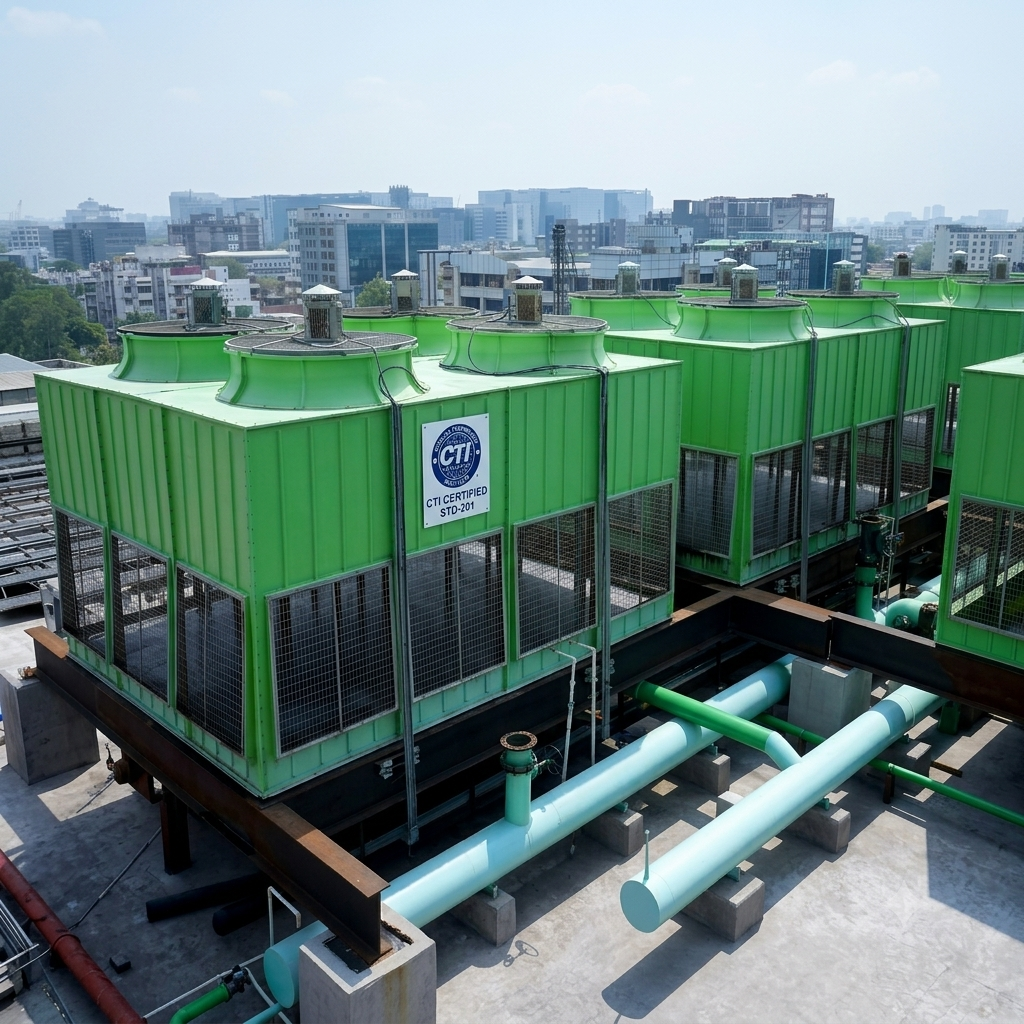
CTI certified bell cooling towers trusted since 1992
On paper, most cooling towers look alike. Two quotes can list the same flow rate, the same hot and cold water temperatures and the same design wet bulb — yet one tower delivers that duty on the hottest afternoon of the year and the other quietly falls short. The difference rarely shows up on commissioning day. It shows up months later as a chiller that trips on high head pressure, a process that has to slow down, or an electricity bill that keeps creeping up.
That is exactly the gap CTI certified cooling towers are designed to close. In this guide we explain what CTI certification means, the ten biggest advantages it brings to owners, consultants and EPC contractors, and how to check that the tower you are buying is genuinely certified.
What is a CTI certified cooling tower?
The Cooling Technology Institute (CTI) is a non-profit technical association founded in 1950 and based in Houston, Texas. It writes the test codes and standards the global cooling tower industry relies on, and it runs the industry’s independent thermal performance certification programme.
That programme is defined by CTI Standard 201 (STD-201). Under STD-201, CTI certifies that every model in a manufacturer’s product line will perform thermally in line with the manufacturer’s published ratings. The standard has two working parts:
- STD-201RS — the rating standard, covering how equipment is tested, rated and how performance data must be published.
- STD-201OM — the operations manual that governs how CTI monitors ongoing compliance.
How it works in practice:
- Qualification test — a CTI-licensed, independent test agency tests a tower from the product line against the manufacturer’s own selection data.
- Certification — if the tower meets its published capacity, the whole line is certified and listed in CTI’s public directory with a validation number.
- Annual reverification — every year, CTI selects a unit from the line at random and tests it again. Fail, and the certification is at risk.
The programme started with open-circuit cooling towers, was extended to closed-circuit cooling towers in 1998, and has covered dry fluid coolers since 2022. It applies to factory-assembled product lines with standard ratings; large custom field-erected towers are instead verified with a site acceptance test under CTI ATC-105.
In short: a CTI certified cooling tower is not just a tower that passed a test once. It is a product line whose catalogue data is independently checked, year after year.
10 advantages of CTI certified cooling towers
1. Thermal performance you can rely on
The core benefit is simple: the tower delivers the cold water temperature it was sold to deliver, at the flow and wet bulb it was selected for. Underperformance in a cooling tower is notoriously hard to spot by eye — the fans run, water flows and the tower looks fine. Certification replaces “trust us” with independent proof.
2. Lower energy costs across the whole cooling system
A cooling tower uses relatively little power itself, but it sets the condenser water temperature for everything downstream. When a tower runs even a degree or two warmer than designed, the chiller compressor has to work harder to reject the same heat, and the tower fans run at full speed for more hours trying to catch up.
The cost adds up. In a published comparison from the Eurovent certification body, an uncertified tower on a roughly 1 MW HVAC heat load needed about 5% more combined chiller and fan electricity each year than a certified tower — more than €12,000 a year in extra running cost at €0.20/kWh. Over a 15–20 year tower life, that dwarfs any small saving on the purchase price.
3. Built-in compliance with ASHRAE 90.1 and green building codes
ASHRAE Standard 90.1 sets minimum efficiency levels for heat rejection equipment in Table 6.8.1-7 — for example, at least 40.2 gpm per fan horsepower for an axial-fan, open-circuit cooling tower at 95°F/85°F/75°F wet bulb. The table names CTI ATC-105 and CTI STD-201 as the way that efficiency is demonstrated.
Because many building codes, government specifications and green building frameworks (including LEED, whose energy prerequisites build on ASHRAE 90.1) reference this standard, choosing a CTI certified cooling tower is the most straightforward way to show compliance without extra paperwork or testing.
4. No expensive field acceptance testing
Many consultant and owner specifications are written as an either/or: the tower must be CTI certified, or the contractor must pay for a field acceptance test by a licensed agency after installation.
Field tests are costly, need the plant running near full heat load, depend on suitable weather, and can only be done once the tower is already installed. If the tower fails, the remedies — adding cells, upgrading fans or derating the plant — are slow and expensive. A certified tower removes that step and that risk entirely.
5. Reduced risk and liability for consultants and EPC contractors
For consulting engineers, MEP firms and EPC contractors, a tower that misses its rating is a reputational and contractual problem. Specifying CTI certified equipment moves the burden of proof to an independent third party: the performance has already been validated, and the manufacturer’s ratings carry CTI’s credibility. That is why so many master specifications and data centre design standards make certification a mandatory line item.
6. Fair, apples-to-apples bid comparison
Without certification, the cheapest bid is often the smallest tower — selected on optimistic data and labelled with the same “nominal tons” as a properly sized unit. Procurement teams have no easy way to tell the difference.
When every bidder must offer a CTI certified model, all selections are made using verified data. Buyers can compare price, footprint, materials and service on a level field, knowing the thermal duty is real. Industry guidance also warns buyers not to inflate design flow or wet bulb to compensate for possible underperformance — a costly habit that becomes unnecessary with certified towers.
7. Confidence in hot and humid climates
Cooling tower performance is most critical — and most often exposed — at high wet bulb temperatures. CTI’s certified operating range covers entering wet bulb temperatures from 10°C up to 32.2°C, which takes in the design conditions of the GCC, coastal India and much of South East Asia.
For projects in the Middle East and other hot, humid regions, where a tower may run near design conditions for months at a time, certified performance at those wet bulbs is a practical safeguard, not a formality.
8. Protects process output and uptime
In industrial plants, cooling water temperature directly affects production. Warmer water means poorer condenser vacuum in power plants, lower yield in chemical processes, slower cycle times in plastics and higher risk of thermal shutdowns in data centres. Industry studies have shown that an under-sized, low-bid tower combined with poor maintenance can push cold water temperature several degrees above design — enough to cost far more in lost output than the tower itself is worth. Certified performance protects that margin from day one.
9. Lower total cost of ownership
A certified tower may occasionally cost slightly more up front, but the lifecycle maths favours it: lower chiller and fan energy, no field test bills, no retrofit to make up for a capacity shortfall and fewer operational surprises. The small price advantage of an unverified tower typically disappears within the first few years of operation.
10. Global recognition and easier approvals
CTI certification is recognised by consultants, owners and authorities worldwide. Eurovent’s cooling tower certification programme in Europe is built on CTI STD-201, and international data centre, district cooling and industrial clients routinely list CTI certification in their tender documents. A certified product line therefore shortens technical approval cycles and opens doors to projects that would otherwise be out of reach.
CTI certified vs non-certified cooling towers at a glance
| Factor | CTI certified cooling tower | Non-certified cooling tower |
|---|---|---|
| Thermal performance | Independently tested; verified every year | Based on manufacturer’s own claims |
| Energy efficiency | Delivers design approach, keeps chiller efficient | Risk of warmer water and higher chiller/fan energy |
| ASHRAE 90.1 compliance | Demonstrated via CTI STD-201 | Requires separate proof or testing |
| Field acceptance test | Usually not required | Often required by specification, at extra cost |
| Bid comparison | Like-for-like on verified data | Hard to compare “nominal” capacities |
| Project risk | Low — third-party validation | Shortfalls found only after installation |
| Lifecycle cost | Lower over 15–20 years | Higher running and remedial costs |
How to verify that a cooling tower is CTI certified
A “CTI certified” claim is easy to check. Before you place an order:
- Search the CTI directory at cti.org for the manufacturer and the exact product line.
- Ask for the CTI validation number and the latest annual reverification letter for that line.
- Confirm the model you are buying is listed within the certified line — not a “similar” or modified model.
- Check the operating point sits inside the certified range (for example, entering wet bulb between 10°C and 32.2°C and a cooling range above 2.2°C).
- Make sure the selection comes from the manufacturer’s CTI-certified selection software or published data.
- Review the installation layout — certification assumes unobstructed airflow, so tight enclosures or poor spacing can still cause recirculation and lost capacity.
Bell Cooling Towers: CTI certified BCTI Series
At Bell Cooling Towers, we believe performance should be proven, not promised. Our BCTI Series of counterflow, induced draught cooling towers is certified by the Cooling Technology Institute under CTI STD-201, and the line is subject to CTI’s annual reverification testing.
That means consultants, EPC contractors and plant owners can select a BCTI tower knowing that its published thermal ratings have been independently validated — whether the project is an HVAC plant in India, a district cooling scheme in the Gulf or a process cooling application at a coastal industrial site.
Looking for a CTI certified cooling tower for your next project? Talk to our engineering team for a certified selection and quotation.
Frequently asked questions
What does CTI certified mean for a cooling tower?
It means the manufacturer’s product line has been tested by an independent, CTI-licensed agency and shown to deliver its published thermal performance under CTI Standard 201, and that the line is retested every year to keep its certification.
Is CTI certification mandatory?
Not by law in most countries, but it is frequently required by consultant specifications, ASHRAE 90.1-based energy codes, green building programmes and large clients such as data centre and district cooling operators. Where it is not required, an expensive field acceptance test is often the alternative.
What is CTI STD-201?
CTI STD-201 is the Cooling Technology Institute’s thermal performance certification standard for factory-assembled evaporative heat rejection equipment and dry coolers. It is made up of STD-201RS (rating and testing rules) and STD-201OM (the operations manual for running the certification).
Do CTI certified cooling towers save energy?
Yes, indirectly and significantly. By delivering the design cold water temperature, a certified tower keeps the chiller or process running at its intended efficiency and avoids fans running harder than necessary. Published comparisons show uncertified towers can increase combined system energy use by around 5%.
Are field-erected cooling towers CTI certified?
STD-201 covers factory-assembled product lines with standard ratings. Large custom or field-erected towers are normally verified with an on-site acceptance test under CTI ATC-105 after installation.
How can I check whether a manufacturer is really CTI certified?
Look up the manufacturer and product line in the CTI certified products directory on cti.org, and ask for the CTI validation number and latest reverification letter for the specific line being offered.
Conclusion
A cooling tower is a long-term investment that sits at the heart of your HVAC or process plant. Choosing a CTI certified cooling tower gives you independently verified thermal performance, lower lifetime energy costs, simpler code compliance and far less project risk — advantages that matter most in demanding climates and critical applications.
If you are planning a new installation or replacing an existing tower, start with a certified product line and an experienced manufacturer. Contact Bell Cooling Towers to discuss a CTI certified solution for your project.